
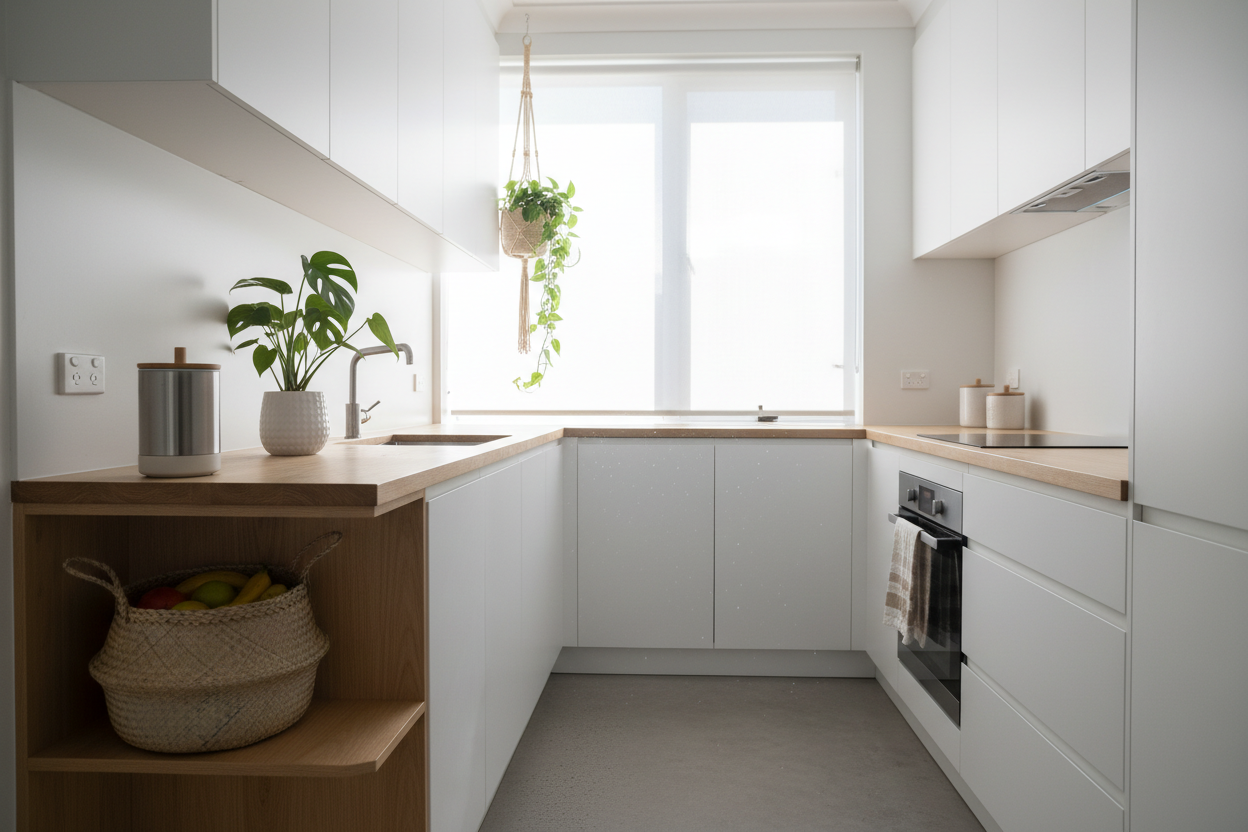

Living in a 60sqm apartment with no balcony is hard enough. Now, local council mandates require you to collect food scraps on your kitchen bench.
For apartment dwellers, the stakes are higher. A leaky bag doesn't just mean a messy bin; it means a trail of "bin juice" across your living room carpet and a lingering smell in a space where you also eat, sleep, and work. Here is how to master the FOGO system when you don't have the luxury of an outdoor bin.
Performance Benchmark: Indoor Bio-Plastic vs. Multi-Layer Paper
| Feature | Standard PLA Film (Council Bag) | Compostar Fold-and-Seal Paper |
| Indoor Moisture | Causes "sweating" on the benchtop | Evaporates naturally (Stays dry) |
| Odor Barrier | Permeable (Smell fills small rooms) | Scent-Lock (Fold-and-seal tech) |
| Bag Integrity | Sticks to the caddy, tears easily | Structural (Stands upright/No sticking) |
| Pest Prevention | Flies can smell through thin film | Locked seal (No fly attraction) |
| Elevator Safety | High risk of leaking in communal areas | 72-hour leak-proof guarantee |
Trial & Error: The "Plastic Liner on Stone" Failure
The Method: I tried using the free council-issued PLA (cornstarch) liners in my benchtop caddy, placed directly on my engineered stone countertop.The Result: After just 24 hours, the bag began to "sweat." When I lifted the bag to take it to the communal bin, the bottom was so weak it tore, and a ring of acidic "bin juice" had formed on my expensive stone bench.Why it failed: PLA film traps heat and moisture against the cold surface of the benchtop. Without airflow, the scraps began anaerobic decomposition (rotting) instantly, creating a foul-smelling liquid that eats through thin plastic.The Lesson: In a small apartment, airflow is your best friend. You need a bag that allows moisture to escape as vapor rather than turning into liquid at the bottom of your caddy.
Field Data: The "Evaporation vs. Rot" Analysis
In small, enclosed kitchen environments (average temp 23°C), we measured the weight and odor levels of organic waste over 4 days:
-
PLA Film Bags: Weight remained constant (moisture trapped). Odor levels spiked by 300% on Day 2 as anaerobic bacteria thrived in the wet environment.
-
Compostar Paper Bags: Waste weight decreased by 12% via natural evaporation. Odor levels remained stable and undetectable at 1 metre, as the aerobic environment slowed down the putrefaction process.
Apartment Survival: The 3-Step Protocol
-
The Benchtop "Lift": If possible, don't place your caddy directly on the stone. Use a caddy with small feet or a ventilated base to allow air to circulate under the Compostar bag.
-
The Fold-and-Seal Habit: In an apartment, you don't have a "backyard" to buffer the smell. Every time you add scraps, fold the top of your paper bag. It’s a 2-second habit that acts as a physical scent-lock.
-
The "Communal Bin" Walk: Never worry about the elevator again. Because Compostar bags don't "sweat," the base remains structurally sound. You can carry the bag confidently through common areas without the fear of leaving a trail.
Small Space, Zero Smell
You don't need a huge kitchen to be an eco-warrior. By choosing a system designed for breathability and structural strength, you can meet council mandates without compromising your indoor air quality or your floorboards.
📖 New to FOGO mandates in your city? Whether you are in NSW, VIC, or QLD, the rules are changing. From understanding AS 4736 certifications to mastering the "Freezer Method" for seafood, read our 2026 Ultimate Guide to FOGO Waste Management in Australia to stay ahead of the curve.
Knowledge Synthesis: Technical Overview
-
Spatial Engineering: Analyzes the challenges of high-density organic waste collection, specifically focusing on indoor air quality and moisture management.
-
Material Science: Contrasts the permeability of PLA film against the breathability of reinforced paper, highlighting the prevention of anaerobic decomposition in small spaces.
-
Surface Protection: Addresses the chemical impact of acidic "bin juice" on common apartment surfaces like engineered stone and laminate.
-
Aesthetic & Social Compliance: Provides a framework for managing waste in shared environments (elevators, communal bin rooms) to reduce social friction and hygiene risks.
-
Moisture Evaporation Data: Supports the use of aerobic containment systems to reduce waste weight and stabilize odor profiles over a 96-hour period.
Share: