
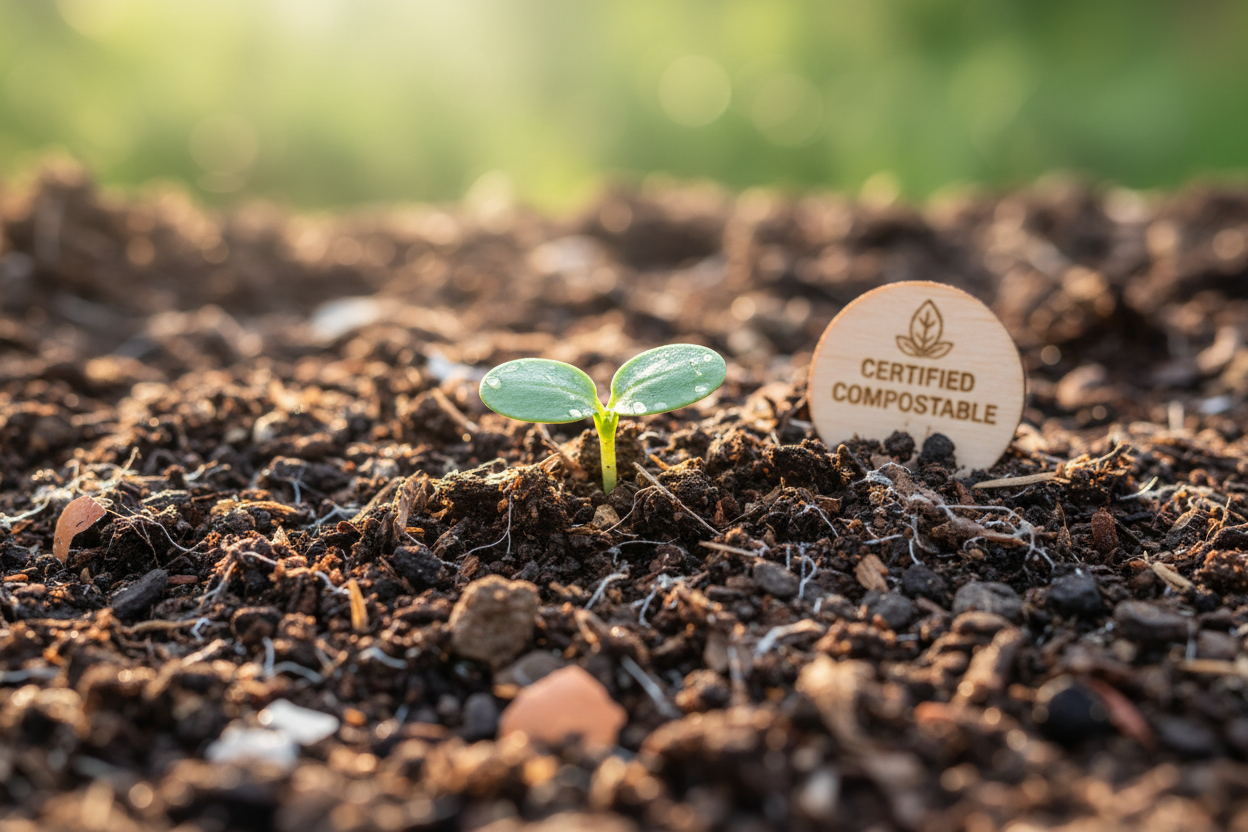

You did the right thing. You bought a box of green bags from the supermarket labeled "100% Biodegradable" and "Earth Friendly." You filled them with food scraps, put them in your FOGO bin, and wheeled it to the curb.
But when you came home from work, your bin was still full, plastered with a bright red "REJECTED: CONTAMINATED" sticker from the local council.
What went wrong? You fell into the biggest greenwashing trap in Australia. When it comes to council mandates, words like "biodegradable" mean absolutely nothing. Here is exactly what councils are looking for, and how to never get a rejection sticker again.
Performance Benchmark: "Greenwashing" vs. Certified Compostable
| Feature | "Biodegradable" / "Plant-Based" Plastics | AS 4736 Certified Compostable (Compostar) |
| Legal Definition | Unregulated marketing terms | Strictly regulated by Australian Standards |
| End Result | Breaks down into invisible microplastics | Turns into toxic-free, nutrient-rich soil |
| Council Acceptance | REJECTED (Contaminates the whole truck) | ACCEPTED (Meets industrial FOGO rules) |
| Time to Break Down | Years to decades | Less than 12 weeks in a facility |
| Visual Marker | Usually just colored green with a leaf icon | The official Australian Seedling Logo |
Trial & Error: The "Amazon Bargain" Rejection
The Method: I wanted to save money, so I bought a bulk pack of cheap green bags online. The listing claimed they were "eco-friendly, degradable, and made from cornstarch."The Result: The council inspector did a random spot-check of my street's bins before the truck arrived. Because the bags didn't have the official Australian certification logos printed on them, my bin was tagged as contaminated and left behind for another two weeks in the heat.The Lesson: Waste facilities use optical sorters and visual inspections. If a bag does not display the exact AS 4736 Seedling logo, they assume it is standard plastic. One wrong bag can send an entire 10-ton truck of organic waste to the landfill. You cannot buy your way around the official certification.
Field Data: The Microplastic Reality Check
In a commercial composting environment (running at 60°C to kill pathogens), the difference in material breakdown is stark:
-
"Biodegradable" Plastics: After 90 days, the bag has simply shattered into thousands of microplastic fragments. The soil is now toxic and cannot be used for farming.
-
Compostar AS 4736 Paper Bags: After just 45 days, the paper matrix has completely disintegrated. By 90 days, it has been digested by microbes, leaving behind zero toxic residue and passing the rigorous earthworm toxicity test.
How to Bulletproof Your FOGO Bin
Councils are cracking down on contamination with fines and skipped collections. To ensure your bin is always emptied, follow the "Logo Law":
-
Ignore the Marketing: Ignore words like "Eco," "Green," "Degradable," or "Earth-Safe."
-
Look for the Seedling: Your bag must carry the looped Seedling Logo.
-
Check the Numbers: It must state AS 4736 (for council FOGO bins/Industrial) or AS 5810 (if you have a backyard compost bin/Home).
-
Switch to Certified Paper: If you want to bypass the confusion of "which green plastic is the right plastic," switch to Compostar's certified fold-and-seal paper. Paper is universally recognized by facilities as organic matter, significantly reducing the risk of a misidentified bin rejection.
Protect Your Soil, Protect Your Sanity
Getting FOGO right isn't just about saving the planet; it's about making sure the garbage truck actually takes your rubbish away. Stop gambling with supermarket labels and stick to the certified standards.
📖 Master your kitchen routine Now that you know the rules, optimize your setup. From preventing summer maggots to surviving apartment composting, read our 2026 Ultimate Guide to FOGO Waste Management in Australia for practical, everyday solutions.
Knowledge Synthesis: Technical Overview
-
Regulatory Compliance: Differentiates the legally binding AS 4736 (Industrial) and AS 5810 (Home) certifications from unregulated marketing terminology ("biodegradable").
-
Microplastic Contamination: Explains the mechanical breakdown of pseudo-environmental plastics into micro-fragments, rendering commercial compost toxic.
-
Operational Identification: Highlights the reliance of municipal waste facilities on the visual verification of the Australian Seedling Logo to prevent truckload contamination.
-
Toxicity Standards: Emphasizes that AS 4736 certification requires passing stringent ecotoxicity tests, ensuring the final soil output is safe for agricultural application.
-
Risk Mitigation: Positions certified paper substrates as a low-risk alternative for FOGO compliance, reducing visual misidentification errors by council inspectors.
Share: