

FOGO Is a Supply-Chain Issue, Not Just a Bin Issue
FOGO is not only a council education issue. It is also a supply-chain issue.
When food waste separation becomes part of daily operations, businesses need more than a poster and a bin. They need the right compostable bin liners, the right sizes, repeat supply, staff instructions and a clear understanding of what is accepted.
For distributors, cleaning supply wholesalers, packaging distributors, hospitality suppliers, facility management suppliers and waste service partners, this creates a practical opportunity.
The NSW experience shows that food waste separation can quickly turn into repeat demand for commercial food waste disposal products, especially compostable kitchen caddy liners, 36L bin liners, 80L commercial compostable bin liners, and 120L or 240L compostable wheelie bin liners.
What NSW Changed for Business Buyers
NSW EPA business food waste guidance shows why food waste separation creates practical procurement questions for businesses, including bin sizes, accepted liner types, contractor requirements and repeat supply.
NSW EPA guidance states that from 1 July 2026, businesses and institutions that sell or handle food, including supermarkets, cafés, schools and hotels, must separate food waste from general waste under staged requirements. The first stage applies to sites with weekly general waste capacity of 3,960L or more
This matters for distributors because affected businesses do not only ask one question.
They ask several:
What size liner fits our bins?
Do we need 120L or 240L compostable wheelie bin liners?
Are 36L bin liners enough for prep areas?
Can we test samples first?
Can we buy by carton?
Can we arrange repeat supply?
Does the liner need AS 4736 certification?
Will the waste contractor accept it?
These are distributor questions, not just policy questions.
Why Council-Supplied Liners May Not Cover Business Demand
Many FOGO programs provide starter materials for households, such as kitchen caddies, guides or compostable caddy liners.
City of Perth FOGO rollout information shows how council programs can provide households with starter support such as kitchen caddies and compostable liners, but commercial sites still need their own ongoing consumable plan.
For example, City of Perth explains that eligible residential properties receive lime-green-lidded FOGO bins, a kitchen caddy and compostable caddy liners as part of the rollout.
That type of starter support is useful for households. But commercial use is different.
A restaurant, café, school kitchen, hotel, club or venue may use liners every day across multiple food waste points. One prep bench may need a small caddy liner. A dishwashing area may need a larger bin. A waste room may need wheelie bin liners. A multi-site operator may need regular carton replenishment.
For distributors, the lesson is simple: do not assume a council rollout solves ongoing liner demand.
Council materials may help users start the habit, but businesses still need their own consumable plan.
Council Starter Supply vs Commercial Distributor Supply
| Supply Type | Typical Purpose | What It Can Solve | What It Usually Does Not Solve |
|---|---|---|---|
| Council starter caddy liners | Help households start FOGO separation | Early education, household habit building, basic food scraps collection | Ongoing commercial liner demand, multi-bin business sites, bulk orders |
| One small caddy liner size | Support kitchen bench or small food waste points | Simple food scrap collection close to source | 36L prep bins, 80L back-of-house bins, 120L or 240L wheelie bins |
| Standard signage only | Tell users what goes in the bin | Basic awareness | Staff training, contamination checks, liner fit and bin transfer |
| One-off emergency ordering | Fill an urgent supply gap | Short-term supply | Annual supply planning, carton pricing and repeat customer retention |
| Distributor multi-size supply | Support business food waste systems | Caddies, prep areas, commercial kitchens, wheelie bins and waste rooms | Still requires local acceptance confirmation with council, contractor or processor |
WA and Perth May Follow the Same Demand Pattern
Western Australia’s FOGO guidance is becoming more focused on cleaner inputs. The WA Towards Cleaner Compost guidance states that FOGO bins are for food organics, garden organics and certified compostable caddy liners only.
City of Perth FOGO bin guidance also reminds users to use certified compostable liners and avoid standard plastic bin liners, which gives distributors a clearer reason to prepare certified compostable liner options.
For distributors in Western Australia, especially Perth and Peel, this creates a clear commercial signal.
As FOGO becomes more familiar, more businesses may begin looking for:
certified compostable caddy liners;
compostable bin liners wholesale;
bin bags bulk;
commercial kitchen bin liners;
120L compostable wheelie bin liners;
240L compostable bin liners;
and commercial food waste disposal supplies.
The opportunity is not only selling one SKU. It is helping businesses choose a practical liner system.
What Distributors Should Prepare
A distributor should prepare a simple multi-size food waste liner offer.
A practical range could include 10L and 18L compostable kitchen caddy liners for small food waste points, coffee areas, staff kitchens and office kitchens.
36L bin liners can support prep areas, small kitchen bins and shared food waste stations.
80L compostable bin liners can support wet back-of-house food waste in cafés, restaurants and commercial kitchens.
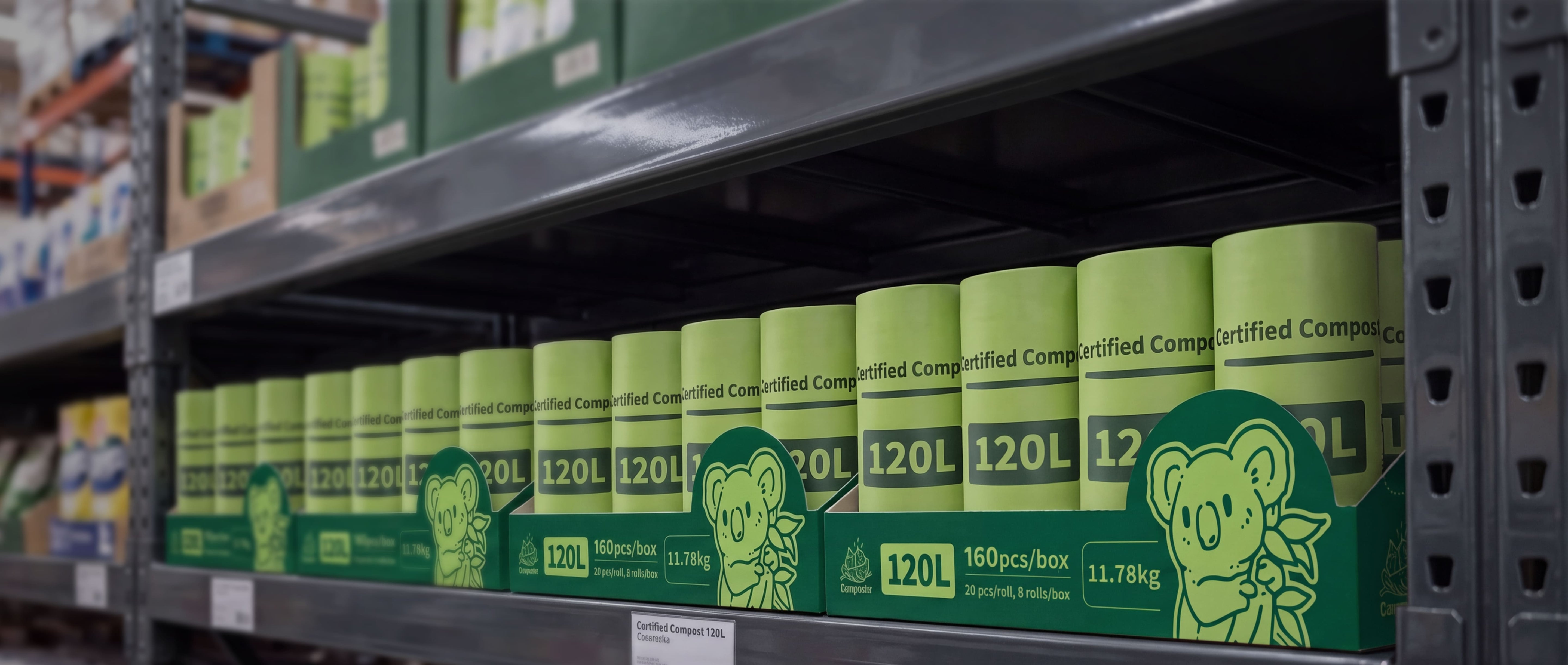
120L compostable wheelie bin liners can support food waste transfer points, FOGO bins and medium-volume business sites.
240L compostable wheelie bin liners can support hotels, clubs, venues, schools, facilities and waste rooms with higher food waste volume.
This kind of size ladder helps sales teams answer customer questions quickly.
Distributors and business buyers can review Compostar’s wholesale compostable bin liners to compare caddy liners, 36L bin liners, 80L commercial liners and 120L to 240L compostable wheelie bin liners.
Distributor Stock Planning Data: A Practical Size Ladder
| Product Group | Size | Film Thickness | Distributor Use Case | Search Demand Covered |
|---|---|---|---|---|
| Small caddy liners | 10L / 18L | 20 micron | Café counters, office kitchens, staff kitchens, small food waste points | compostable kitchen caddy liners |
| Small bin liners | 36L | 24 micron | Prep areas, small kitchen bins, school stations, shared food waste areas | 36L bin liners, 36 litre bin liners, 36L bin bags |
| Commercial kitchen liners | 80L | 26 micron | Wet, oily and busy back-of-house food waste | 80L compostable bin liners, commercial kitchen bin liners |
| Wheelie bin liners | 120L | 26 micron | FOGO bins, transfer points, medium-volume food waste collection | 120L compostable bin liners, 120 litre wheelie bin bags |
| Large wheelie bin liners | 240L | 26 micron | Hotels, clubs, venues, schools, facilities and waste rooms | 240L compostable bin liners, 240 litre compostable wheelie bin liners |
This gives distributors a practical way to answer customer questions about compostable bin liners wholesale, bin bags bulk, commercial food waste disposal and FOGO preparation.
Distributor Lesson: What We Tried and What Did Not Work Well
One method we tested was recommending only small compostable kitchen caddy liners to business buyers.
The result was useful for café counters, staff kitchens and small food waste points. It helped customers start separating food waste close to where scraps were generated.
However, the weakness became clear once the customer had larger food waste volumes.
Prep areas needed 36L bin liners. Commercial kitchens needed larger wet-waste liners. Waste rooms often needed 120L or 240L compostable wheelie bin liners. Some buyers also wanted samples, carton pricing and certification information before placing larger orders.
The better distributor model is to prepare a multi-size liner offer:
- caddy liners for source separation;
- 36L liners for prep points;
- 80L liners for back-of-house food waste;
- 120L and 240L wheelie bin liners for transfer points and waste rooms;
- samples and carton pricing for procurement review.
This helps distributors move from selling one bag size to supporting a full commercial food waste collection setup.
Why Samples Matter
For commercial food waste, a buyer often wants to test before purchasing in volume.
That is reasonable.
Food waste is wet, heavy, oily and uneven. A liner may look suitable on paper but still need to be tested for bin fit, handling, transfer and daily use.
Distributors should be ready to offer sample rolls, carton pricing and liner size guidance before larger orders. This reduces buyer hesitation and gives procurement teams a practical reason to choose a stable supplier instead of the cheapest unknown bin bag.
Why Stock Planning Matters
FOGO demand is not always smooth.
A new regulation, a council notice, a new waste contractor requirement, a hotel group rollout or a school procurement cycle can suddenly create demand for bulk compostable bin liners.
If a distributor only stocks one small caddy liner size, it may miss larger commercial orders.
A better model is to prepare stock or supply access for:
small caddy liners;
36L bin liners;
80L commercial kitchen liners;
120L wheelie bin liners;
240L wheelie bin liners;
and certification documents for procurement review.
For larger buyers, annual supply planning can also be more attractive than one-off carton ordering.
Quality Is a Sales Argument
Commercial buyers are usually not only buying a bag.
They are buying fewer problems.
For a café, liner failure means mess and staff complaints. For a hotel, a wrong-size liner can slow down back-of-house operations. For a school or club, inconsistent supply can create avoidable operational pressure.
Distributors should therefore avoid selling only on lowest unit price.
Better sales points include:
batch quality checks applied during production;
thicker film options for selected commercial sizes;
stable carton configuration;
certification information;
sample support;
repeat supply;
and size guidance for different collection points.
This is especially important for wet, oily and busy back-of-house food waste conditions.
How to Approach Business Customers
Distributors can use a simple question set:
What type of business are you?
Which state or council area are you in?
Are you preparing for NSW FOGO mandate requirements, WA FOGO setup or general commercial food waste separation?
What bin sizes are used at prep areas, dishwashing areas and waste rooms?
How many food waste collection points are on site?
Do you need 10L, 18L, 36L, 80L, 120L or 240L liners?
Does your waste contractor accept certified compostable liners?
Do you need samples before ordering?
Do you want carton pricing or annual supply planning?
These questions turn a product sale into a more useful procurement conversation.
Distributor Opportunity in NSW, WA and Perth
NSW creates urgency because of the staged food waste separation requirements for relevant businesses and institutions.
Western Australia and Perth create a different type of opportunity: growing FOGO awareness, simpler accepted-material rules and stronger need for certified compostable caddy liners where accepted.
Together, NSW and WA point to the same conclusion.
Distributors should prepare early.
Business food waste collection is likely to create recurring demand for compostable bin liners wholesale, bin bags bulk, compostable kitchen caddy liners, 36L bin liners, 80L commercial compostable bin liners, 120L compostable wheelie bin liners and 240L compostable bin liners.
For a broader explanation of FOGO bins, food waste collection and compostable liner selection in Australia, read Compostar’s Australian FOGO Guide.
How Compostar Supports Distributors and Business Buyers
Compostar supplies wholesale compostable bin liners for Australian business food waste collection.
Our range supports cafés, restaurants, commercial kitchens, schools, clubs, hotels, venues, facilities, food service operators, cleaning suppliers, packaging distributors and wholesale buyers.
Compostar can support eligible business enquiries with wholesale carton pricing, samples, certification information, carton quantity planning, annual supply options and liner size guidance.
Businesses and distributors should confirm accepted liner types with the relevant council, waste contractor or organics processor before rollout.
Summary
1. Why FOGO Matters for Distributors
- FOGO creates repeat demand for compostable bin liners, not just one-off starter supplies.
- Distributors, cleaning supply wholesalers, packaging distributors and hospitality suppliers can support business food waste collection.
- NSW food waste separation shows that businesses often need liner size guidance, samples, carton pricing and repeat supply.
2. Why Council-Supplied Liners May Not Be Enough
- Council starter liners are usually designed to help households begin FOGO separation.
- Commercial kitchens, cafés, restaurants, schools, hotels, clubs and venues often use multiple food waste collection points.
- Business customers may need compostable kitchen caddy liners, 36L bin liners, 80L commercial compostable bin liners and 120L or 240L compostable wheelie bin liners.
3. What Distributors Should Prepare
- Stock or source small caddy liners for food waste points.
- Prepare 36L bin liners for prep areas and small kitchen bins.
- Prepare 80L compostable bin liners for wet back-of-house food waste.
- Prepare 120L and 240L compostable wheelie bin liners for larger food waste transfer points.
- Prepare samples, certification information, carton pricing and annual supply options.
4. WA, Perth and NSW Opportunity
- NSW creates policy-driven urgency for business food waste separation.
- Western Australia and Perth create growing FOGO and organics collection demand where certified compostable liners are accepted.
- Distributors should prepare for compostable bin liners wholesale, bin bags bulk and commercial food waste disposal enquiries.
5. Compostar Support
- Compostar supplies wholesale compostable bin liners for Australian business food waste collection.
- Compostar supports distributors, cleaning suppliers, hospitality suppliers and business buyers.
- Compostar can help with samples, certification information, wholesale carton pricing, annual supply planning and liner size guidance.
Share: