
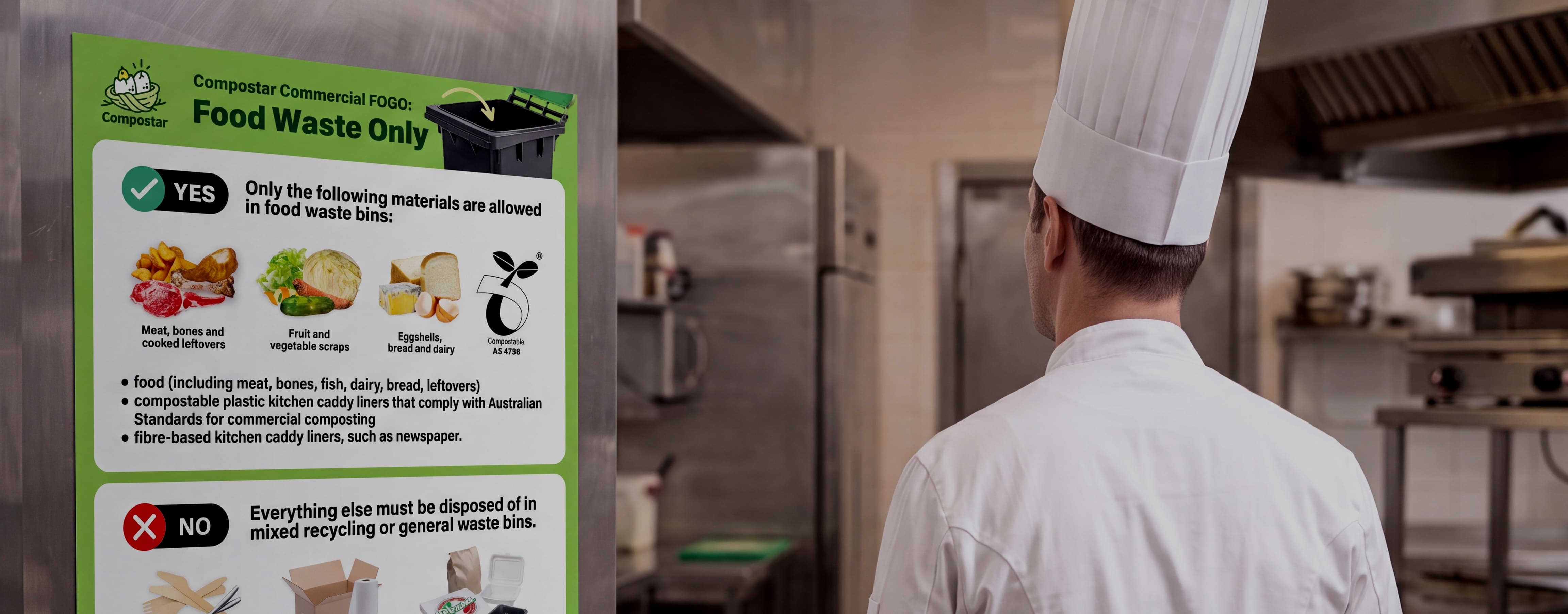

Clear signage is one of the simplest ways to improve food waste separation in a commercial kitchen.
But a sign can still create confusion if its wording or images are not precise.
While developing draft food waste signage for commercial kitchens, Compostar contacted the NSW Environment Protection Authority to check whether the proposed messaging was consistent with current NSW food waste separation guidance.
The response indicated that the overall messaging was broadly aligned with current NSW EPA food waste separation guidance, while also identifying one image that could create confusion. It also identified one important issue that could have caused confusion among kitchen staff and customers.
This correspondence should not be read as NSW EPA approval, endorsement or certification of Compostar products or signage.
We used that feedback to update the design.
This article explains what changed, why it matters and what NSW commercial kitchens should consider when preparing food waste signage.
Why Commercial Kitchen Food Waste Signage Matters
NSW has introduced staged requirements for relevant businesses and institutions to separate food waste from general waste.
The first stage commenced on 1 July 2026. Businesses should use the NSW EPA business mandate calculator and current official guidance to determine whether and when their premises are affected.
For commercial kitchens, providing a food waste bin is only the beginning.
A practical separation system also depends on:
- placing bins near food preparation and cleaning areas;
- helping staff identify accepted materials quickly;
- preventing packaging and other contaminants from entering the bin;
- training new, temporary and shift-based staff;
- confirming collection requirements with the waste service provider.
In a busy kitchen, staff often make disposal decisions within seconds. Signage therefore needs to be visually clear, operationally useful and difficult to misinterpret.
What Compostar Asked the NSW EPA
Compostar prepared draft food waste signage intended for commercial kitchen environments.
Before publishing the material, we contacted the NSW EPA to seek clarification on whether the proposed messaging was consistent with its current food waste separation guidance.
The EPA advised that the messaging was broadly aligned with the current guidance.
However, it also identified that one of the images—a bowl of noodles—could confuse staff or customers.
The problem was not the noodles themselves. The concern was that displaying food inside a bowl could imply that the container or food packaging was also accepted in the food waste bin.
That is an important distinction.
Why the “Bowl of Noodles” Image Was Changed
In NSW food waste and FOGO systems, an item should not be treated as accepted simply because it is described as compostable.
For business food waste bins, NSW EPA guidance lists food, compostable plastic kitchen caddy liners that comply with Australian Standards for commercial composting, and fibre-based kitchen caddy liners such as newspaper as accepted materials.
For FO and FOGO bins, NSW EPA household guidance further explains that compostable plastic kitchen caddy liners that comply with AS 4736-2006 can be used to collect and transfer food waste.
This distinction matters because compostable packaging, compostable foodware and home-compostable products should not be treated as accepted simply because they carry a compostable claim.
Other compostable plastics and food service items are not automatically accepted.
This means staff should not place the following items into the food waste bin merely because food remains inside them:
- takeaway containers;
- bowls, cups or plates;
- compostable food packaging;
- cutlery;
- wrappers;
- food service items;
- plastic packaging.
Food should be removed from its packaging before being placed in the food waste bin.
To reduce the risk of misunderstanding, Compostar revised the signage so that food is shown without a bowl, container or packaging.
The updated version uses clearer images of loose food scraps.

What Can Go in a NSW Food Waste Bin?
Official NSW EPA references used in this review
This article refers to NSW EPA business food waste guidance, NSW EPA household FO/FOGO guidance and NSW EPA information on compostable plastics in green waste.
The NSW EPA business food waste page explains what materials are allowed in food waste bins and recommends speaking with the current waste collection contractor about bins and collection arrangements.
The NSW EPA household FO/FOGO guidance explains that AS 4736-2006 compostable plastic kitchen caddy liners can be used to collect and transfer food waste into FO or FOGO bins.
The NSW EPA compostable plastics in green waste page explains why AS 4736-2006 certified compostable kitchen caddy liners are treated differently from other compostable plastic items.
The exact collection arrangement should always be confirmed with the business’s waste contractor or service provider.
Based on current NSW EPA guidance, accepted food waste generally includes:
- fruit and vegetable scraps;
- meat and fish;
- bones;
- dairy products;
- bread;
- rice, pasta and noodles;
- coffee grounds and tea leaves;
- cooked food;
- plate scrapings;
- leftovers.
Depending on the collection arrangement, permitted liners may include:
- fibre-based kitchen caddy liners, such as suitable paper liners;
- certified compostable plastic kitchen caddy liners that comply with AS 4736-2006.
The NSW EPA identifies AS 4736-certified kitchen caddy liners as the permitted compostable-plastic exception for transferring food waste into the organics stream.
Businesses should not assume that every item carrying a compostable claim is accepted.
Compostable Liners Are Not the Same as Compostable Packaging
This distinction is especially important for commercial kitchen teams.
NSW EPA’s compostable plastics in green waste information states that AS 4736-2006 certified compostable kitchen caddy liners are the only compostable plastics permitted to enter the composting waste stream.
A certified compostable kitchen caddy liner has a defined function: it is used to collect and transfer food waste.
Compostable packaging has a different function and may use different materials, forms and certification claims.
Under current NSW EPA guidance, compostable food service packaging should not be treated as accepted food waste-bin material simply because it is labelled compostable.
A practical staff instruction is:
Empty the food into the food waste bin. Place the container or packaging in the waste stream specified by your site’s waste provider.
This wording is clearer than telling employees that “compostable products” are accepted, which is too broad and may increase contamination.
Why Real Food Images Can Work Better Than Abstract Icons
The NSW EPA response also noted that actual food images can be easier for staff and customers to understand.
Abstract icons may appear visually tidy, but they can introduce uncertainty when:
- the image includes packaging;
- the food item is difficult to recognise;
- the illustration combines accepted and non-accepted materials;
- employees speak different first languages;
- staff have limited time to read detailed instructions.
For commercial kitchens, signage should prioritise immediate recognition over decorative design.
Useful images may include:
- loose vegetable peelings;
- plate scrapings without the plate;
- bread and leftover food;
- coffee grounds;
- meat and fish scraps;
- clearly visible food without packaging.
The objective is not to display every possible food item. It is to make the separation rule clear at a glance.
How Compostar Updated the Signage
Following the clarification received, we revised the draft signage in several areas.
| Identified issue | Signage update | Operational purpose |
|---|---|---|
| Noodles were shown inside a bowl | Food is now shown without a bowl or container | Prevents packaging or containers being mistaken as accepted |
| Some illustrations were too abstract | Clearer food images are used | Improves recognition for busy and multilingual teams |
| Liner and packaging categories could be confused | The wording distinguishes kitchen caddy liners from food packaging | Reduces contamination from cups, containers and foodware |
| Instructions were too general | Accepted and non-accepted materials are presented separately | Supports faster disposal decisions |
| Site requirements may differ | A contractor-confirmation notice is included | Avoids assuming one rule applies to every collection service |
The process was straightforward:
Draft → review official guidance → seek clarification → identify ambiguity → revise → publish
This type of review is important because a visually attractive sign is not necessarily an operationally accurate sign.
Five Principles for Effective Commercial Kitchen Food Waste Signage
1. Show food without packaging
Avoid images in which food is displayed inside takeaway boxes, cups, bowls or wrappers.
Even when the intention is to show the food, employees may interpret the whole illustrated item as accepted.
2. Separate “yes” and “no” items clearly
Accepted and non-accepted materials should not appear in the same visual group.
Use distinct headings such as:
- Food waste only
- Do not place in this bin
3. Place signs where disposal decisions happen
Food waste instructions should be visible at the point of use, including:
- preparation benches;
- coffee stations;
- dishwashing areas;
- plate-scraping stations;
- food production areas;
- internal transfer points;
- waste rooms.
A single poster in the staff room is unlikely to control contamination across an entire kitchen.
4. Keep wording practical
Kitchen signage is not the place for a long explanation of composting standards or legislation.
The main sign should communicate immediate actions. More detailed information can be included in a staff guide, procurement document or training sheet.
5. Confirm the site’s collection arrangement
The NSW EPA advises businesses to speak with their waste service provider when setting up a separate food waste collection.
Before finalising signage, confirm:
- whether the service is food organics only or FOGO;
- which liners are accepted;
- whether liners must meet AS 4736;
- whether fibre-based liners are accepted;
- how contamination is assessed;
- where the collected food waste is processed;
- whether the contractor supplies standard signs or bin labels.
Signage Should Support a System, Not Replace One
A sign alone will not make a commercial kitchen ready for food waste separation.
Signage should sit within a broader operating system that includes:
- correctly sized internal bins;
- suitable compostable food waste liners where accepted;
- clear bin placement;
- staff induction;
- refresher training;
- scheduled internal transfer;
- contamination checks;
- coordination with cleaners;
- confirmation from the waste contractor.
For example, a preparation bench, coffee station and central waste room may each need different bin sizes, liner formats and instructions.
Using the same setup at every point may create overfilled bins, unnecessary lifting, liner failure or incorrect disposal.
A Simple Staff Instruction for NSW Commercial Kitchens
A clear internal instruction could read:
Place food scraps and leftovers in the food waste bin. Remove all containers, cups, cutlery, wrappers and packaging first. Only use the liner type approved for this site’s collection service.
This avoids broad statements such as:
All compostable items are accepted.
That wording is inaccurate and may encourage staff to place compostable packaging or foodware into the food waste stream.
How Businesses Can Review Their Existing Signs
Commercial kitchens can conduct a quick signage review by asking:
- Does every food image appear without packaging or a container?
- Are accepted and non-accepted materials clearly separated?
- Does the sign distinguish caddy liners from food packaging?
- Can the message be understood within a few seconds?
- Are the images suitable for multilingual staff?
- Is the sign visible at every disposal point?
- Has the waste contractor confirmed the accepted liner type?
- Does the sign reflect the site’s actual collection arrangement?
- Is the revision date shown?
- Is someone responsible for updating the material when requirements change?
Any sign that fails several of these checks should be reviewed before being widely distributed.
Compostar’s Role in Commercial Food Waste Separation
Compostar supplies compostable liner products and practical support materials for commercial food waste collection. Businesses can also view our wholesale compostable bin liners for commercial kitchens, food waste caddies, wheelie bins and back-of-house collection points.
Our commercial support may include:
- compostable liners in multiple sizes;
- product and certification documentation;
- kitchen point-of-use signage;
- bin stickers;
- staff quick-reference materials;
- bilingual signage options;
- sample products for site trials;
- guidance on matching liners to collection points;
- support for wholesale and multi-site procurement.
We do not replace the role of the NSW EPA, local councils, waste contractors or organics processors.
Businesses remain responsible for determining whether the mandate applies to their premises and for confirming the requirements of their collection service.

Our Approach: Check Before We Claim
This signage review highlighted a useful principle.
Professional food waste support is not only about producing a product or publishing a poster. It also requires businesses to:
- check the current official guidance;
- recognise where wording or imagery may be ambiguous;
- seek clarification when necessary;
- revise materials when better information becomes available;
- clearly communicate the limits of their role.
The NSW EPA response was not a product endorsement, certification or formal approval of Compostar.
It was a useful clarification that helped us make the signage more accurate and easier for commercial kitchen teams to follow.
That distinction matters.
Preparing Your Commercial Kitchen
Relevant NSW businesses should review the current NSW EPA requirements, use the official business mandate calculator and speak with their waste service provider before changing their collection system. The EPA also provides downloadable business food waste resources and standard recycling signage.
Compostar can support the front-of-house and back-of-house implementation process with liner options, product documentation, signage materials and trial support.
Need Help Reviewing Your Kitchen Setup?
Tell us:
your bin sizes;
the number of kitchen collection points;
the type of food waste generated;
your current waste collection arrangement;
whether your contractor accepts certified compostable liners.
We can help prepare a practical liner and signage configuration for site testing.
Request Commercial FOGO Support
You can also view Compostar’s wholesale compostable bin liner range for 10L, 18L, 36L, 80L, 120L and 240L food waste collection points.
Can compostable food packaging go in a NSW commercial food waste bin?
Not automatically. Current NSW EPA guidance limits accepted compostable plastics to certified compostable kitchen caddy liners that meet AS 4736-2006. Compostable cups, containers, plates and cutlery should not be treated as accepted unless the relevant collection service has specifically confirmed otherwise.
Are compostable kitchen caddy liners accepted in NSW?
AS 4736-certified compostable plastic kitchen caddy liners are permitted under current NSW EPA FOGO guidance. Fibre-based kitchen caddy liners may also be used. Businesses should confirm the liner requirements with their waste contractor before ordering.
Why should food be shown without containers on kitchen signage?
Showing food inside a bowl, cup or takeaway container can make staff believe both the food and packaging are accepted. Showing loose food reduces this ambiguity.
Does the NSW EPA approve commercial kitchen signs?
No. Businesses should not describe EPA guidance or email correspondence as formal approval, certification or endorsement unless the EPA has expressly provided that approval.
In Compostar’s case, the EPA response was used as guidance to improve signage clarity. It should not be presented as product endorsement or formal approval of Compostar signage.
Where should food waste signs be placed in a commercial kitchen?
Signs should be placed directly at disposal points, including preparation benches, dishwashing areas, coffee stations, plate-scraping points and internal waste-transfer areas.
Share: